
Across 18 foreign-university India campuses, ChatGPT visibility is high and sentiment is positive. The exposure sits one layer deeper: when a model needs an India-specific fact, it cites Shiksha and Careers360 instead of your campus site. Here is what the data shows and what to fix before the 2027 applicant cohort.
A family in Pune deciding between a UK campus in GIFT City and an Australian campus in Bengaluru is no longer starting on Google. They are asking ChatGPT, Perplexity, and Google AI Overviews directly.
“Which foreign university has an India campus for an MBA?” “Is the Wollongong GIFT City degree the same as the Australian one?” “Compare Deakin and Lancaster India fees.” Those queries used to return ten blue links the campus marketing team could influence. Now they return one synthesized answer assembled from whatever sources the model trusts most.
For foreign-university India campuses the headline finding from our 18-campus research is reassuring on the surface. The exposure has little to do with whether AI tools mention you. What matters is which source they cite when the question turns India-specific.
The AI Visibility Picture Is Strong
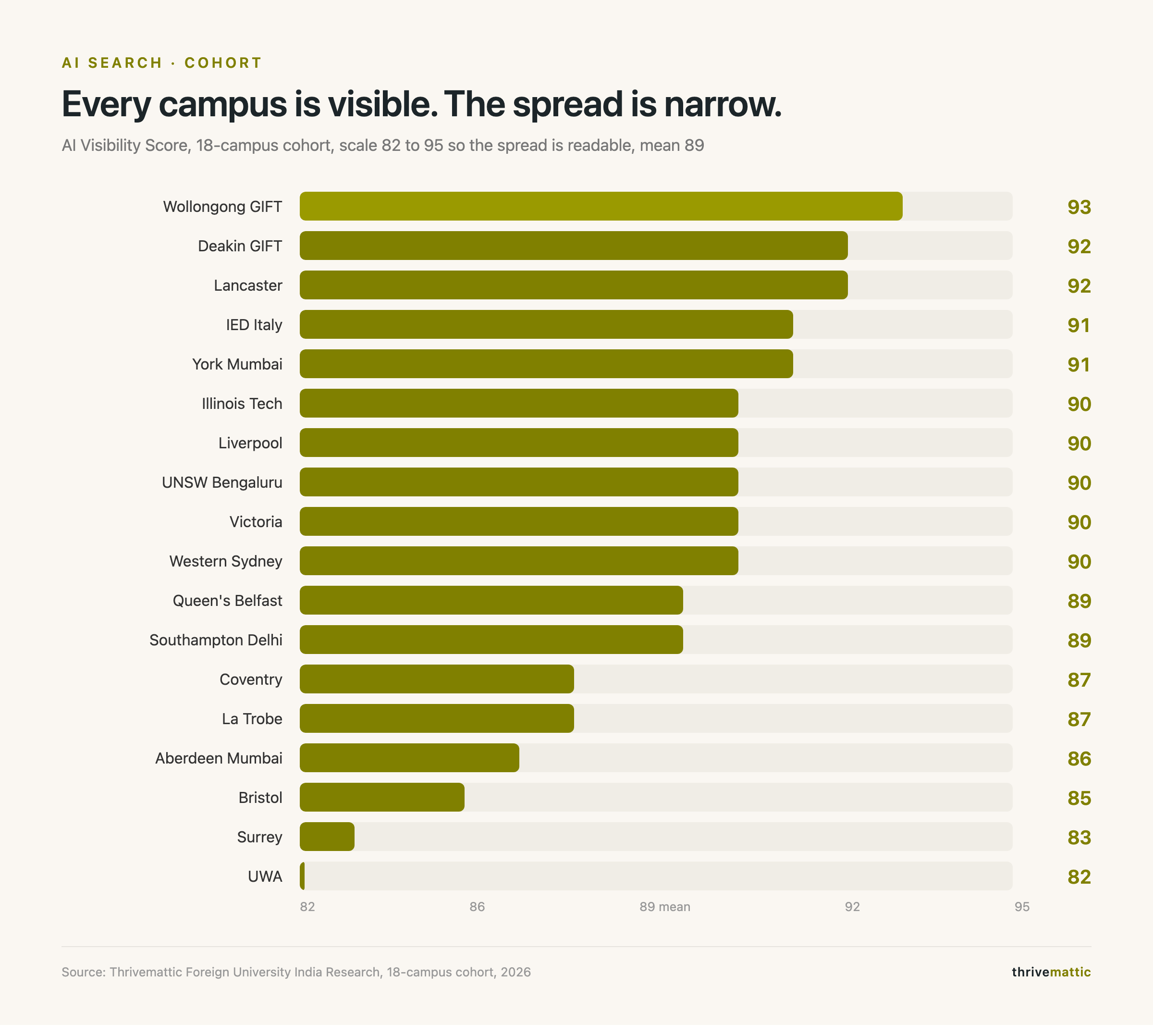
Here is what the data shows across the 18 campuses we tested for AI visibility:
- Cohort mean AI Visibility Score: 89 out of 100, with a tight range of 82 to 93
- Highest: University of Wollongong’s GIFT City campus at 93
- Lowest: University of Western Australia at 82, with Surrey close behind at 83
- ChatGPT sentiment: 16 of the 18 campuses are positive, with only 2 mixed (Surrey and UWA)
In AI search, the variance is in mention count — not warmth
Each dot is one of the 18 foreign-university India campuses. ChatGPT mention count on the horizontal axis, sentiment score on the vertical. Sentiment is tight (64–86) and mostly favorable across the cohort. The lever is whether the campus gets mentioned at all. Hover or tap any campus for the detail.
The scatter makes the cohort shape explicit. Sentiment is compressed into a 22-point band from 64 to 86, and 16 of the 18 dots sit above the 78 cohort mean. The horizontal axis is where the variance lives: mention counts run from 18 to 35, almost a 2× spread. Wollongong shows the tension cleanly — the warmest sentiment in the cohort at 86, paired with the fewest mentions at 18. Deakin and Lancaster cluster in the loud-and-warm corner at 35 mentions and 85 sentiment, and those are the names a model returns first when an India applicant asks a comparison question.
Surrey and UWA are the two cool outliers the headline already named. Both sit at average mention volume but well below the warmth band, which is why the cohort numbers describe them as “mixed” rather than positive. That is the practical lens for AI search on this cohort: warmth is broadly granted, and the lever is whether the model thinks to mention your India campus at all.
These are healthy numbers. The score range is narrow, which means no campus in the cohort is invisible to AI-assisted discovery the way some domestic institutions are. Parent brands carry weight. When a model is asked about the University of Surrey or Illinois Tech, it knows the institution exists, can place it, and generally describes it favourably.
A cohort mean of 89 with positive sentiment looks like a solved problem. It is not. The number measures whether the model knows the parent university. It does not measure whether the model can answer the question the India applicant actually asked.
Where the India-Specific Gap Opens
We ran five fact-pattern prompts designed around the questions an India applicant asks: degree parity with the home campus, India campus fees, GIFT City versus mainland-India delivery, intake timelines, and recognition in India. We then counted how often each campus’s own India presence was referenced in the answer.
The cohort mean was 28 India-context mentions across those five prompts. The spread is the story:
- Leading: Deakin’s GIFT City campus and Lancaster both reach 35
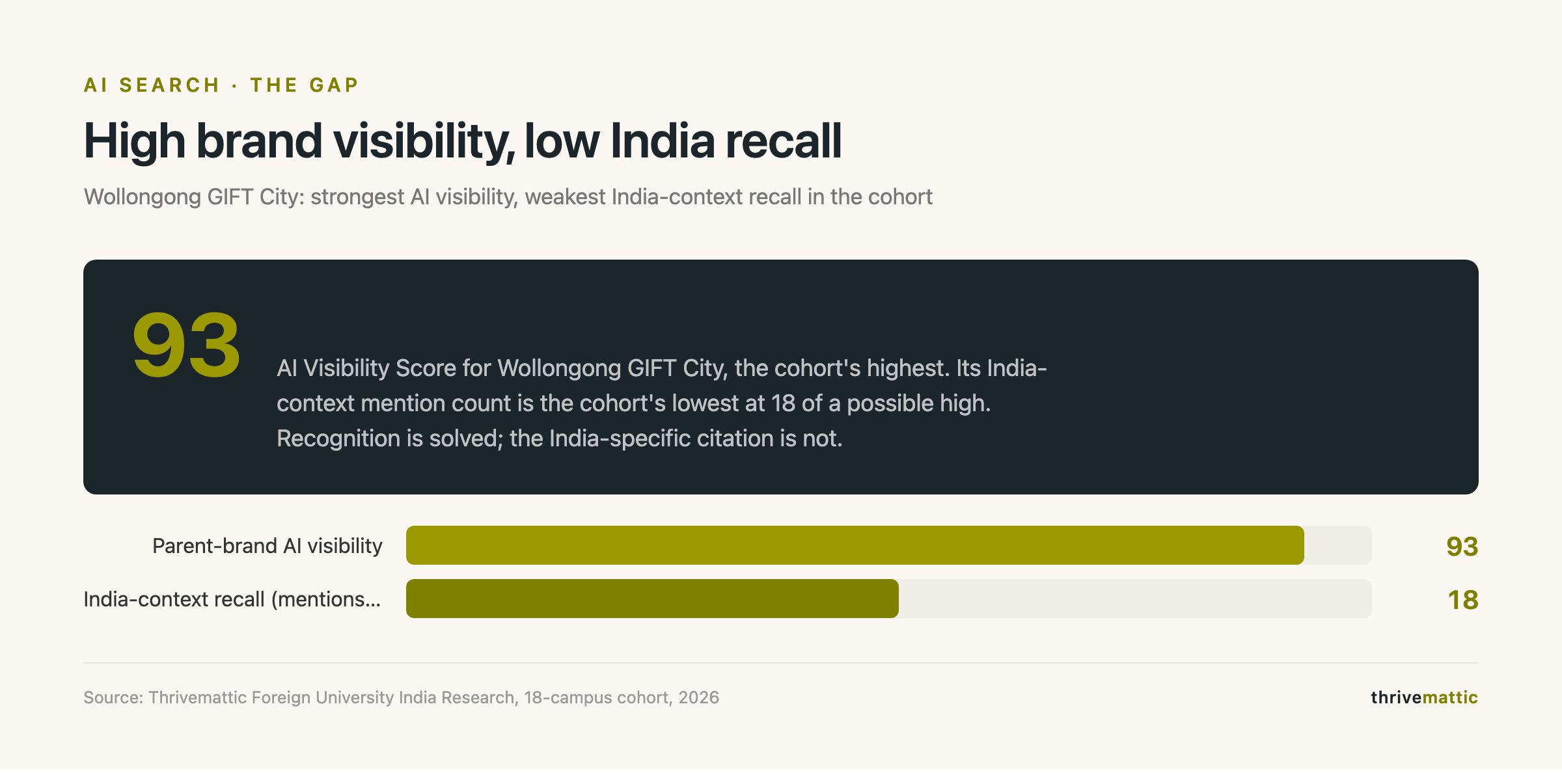
- Lowest: Wollongong’s GIFT City campus at 18, despite holding the highest overall AI Visibility Score of 93
- Mid-pack: UNSW Bengaluru at 22
Wollongong is the clearest illustration. It scores 93 on parent-brand AI visibility and 18 on India-context mentions. The model is confident about the University of Wollongong. It is far less able to speak to the GIFT City campus specifically, so it either generalises from the Australian campus or reaches for a third-party source.
That gap between parent-brand recognition and India-specific recall is the readiness problem for this cohort. It does not show up as a low headline score. It shows up the moment the question gets specific.
Why Models Reach for Shiksha Instead of You
When a model lacks a confident India-specific fact, it falls back to the most authoritative indexed source for that fact. For foreign-campus India queries, that source is repeatedly an aggregator: Shiksha, Careers360, or a comparison portal.
The reason is mechanical. India subdomains and India landing pages for these campuses carry thin structured data. Course, FAQ, and EducationalOrganization JSON-LD is sparse or missing on the India properties, even when the parent domain is well marked up. A model parsing the page finds prose but little machine-readable structure about the India campus’s fees, intakes, accreditation, or degree parity. The aggregators, by contrast, publish that same information in clean, comparable, structured formats across thousands of profiles.
The result is predictable. The model cites the aggregator’s version of your India fees, your India intake calendar, and your degree-parity statement. That becomes the answer a prospective family reads, attributed with the authority of an AI-generated response, and it was not written by you.
This pattern is visible in the search results data too. Brand-name search for these campuses is largely owned, but the higher-intent India queries are exactly where aggregator pages compete most. AI models lean on the same sources that rank in traditional search, so the citation gap in AI answers tracks the structured-data gap on the India properties.
The Retraining Lag Makes This Urgent
There is a timing dimension that changes how this should be prioritised. AI-search models retrain on a one-to-two-year lag. Structured data you publish on your India subdomain in mid-2026 does not influence answers immediately. It surfaces for the applicant cohort researching in 2027.
That has a direct planning consequence. The structured-data work done this quarter is what shapes how the model describes your India campus to the August 2027 intake. Work deferred to 2027 affects 2028 and 2029. For a campus still building India awareness, the compounding cost of waiting is larger than it appears, because every cycle of thin India structured data is another cycle of aggregator-sourced answers entering the next training set.
There is a second-order effect worth naming. Once an aggregator’s version of your India fees or degree-parity statement enters a training set, it does not simply disappear when you fix your own pages later. It persists in the model’s prior until enough fresher, better-structured signal from your own properties outweighs it. The practical reading is that the cost of a missing India schema block is not one cycle. It is the time to publish plus the retraining lag plus the time for your corrected signal to overtake the stale one. That argues for treating the India structured-data fix as a current-quarter item rather than a backlog item, regardless of how healthy the headline AI Visibility Score looks today.
A Practical Readiness Audit
This audit fits a small team and one focused week. It produces a prioritised list that informs both SEO and generative-engine work.
Step 1: Run the India fact-pattern prompts. Use the five questions an India applicant actually asks. Degree parity with the home campus. India campus fees. GIFT City versus mainland delivery. Intake timelines. Recognition and accreditation in India. Run each in ChatGPT, Perplexity, and Google AI Overviews. Record every answer verbatim.
Step 2: Trace the citation. For each answer, identify the source. When the model names or links a source, note whether it is your India property or an aggregator. When it does not cite, check whether the facts match your site or a Shiksha or Careers360 profile. This tells you precisely where you have lost the India narrative.
Step 3: Audit India structured data. Inspect the India subdomain and India landing pages for Course, FAQ, and EducationalOrganization JSON-LD. Compare against the parent domain, which is usually marked up far better. The delta between parent and India markup is the single highest-return finding in this audit, because it explains most of the citation gap and it is the part you fully control.
Step 4: Reconcile the facts everywhere. Your India fees, intake dates, and degree-parity statement should read identically on your India site, your aggregator profiles, and any partner pages. Inconsistency lets a model pick the least favourable version. Consistency plus owned structured data is what moves the citation back to you.
Audit output: a prioritised plan mapping each India-specific representation gap to a specific content or schema fix, sequenced against the retraining lag.
Generative Engine Optimization for an India Campus
Generative engine optimization for a foreign campus in India is narrower than the general higher-education version, because parent-brand visibility is already solved. The work concentrates on three things.
1. Structured data on the India properties, not just the parent domain. The parent university site is typically well marked up. The India subdomain often is not. Publishing Course, FAQ, and EducationalOrganization JSON-LD on the India pages, covering India fees, intakes, accreditation, and degree parity, is the highest-return action available to this cohort.
2. India-specific facts on owned pages, stated plainly. Models cite the source that answers the exact question. If degree parity, India fee structure, and GIFT City versus mainland delivery live as clear, current, machine-readable content on your India site, the model has a reason to cite you rather than an aggregator profile.
3. Consistency across every India-facing property. Your India site, aggregator profiles, partner pages, and any India social presence should state the same fees, intakes, and recognition status. Inconsistency is what hands the answer to the aggregator. This aligns with what the community discussion data shows India applicants are most uncertain about, which is exactly where a confident, consistent owned answer pays off.
What This Means for the Next India Cycle
The cohort mean of 89 on AI Visibility is a floor, not a finish line. It confirms parent-brand recognition is intact. It says nothing about whether a model can accurately describe your India campus when a family asks the question that decides the application.
The campuses that close the parent-versus-India recall gap now, while there is still a clear training-lag runway, are the ones whose India story will be told accurately to the 2027 cohort. The campuses that wait will keep reading their own India fees and intake dates back to prospective families through a Shiksha profile they do not control.
The shift in how India families research foreign campuses is already here. The question is whether the AI-generated answer about your India campus is yours, or an aggregator’s.
This is Part 3 of a 5-part series based on Thrivemattic’s 18-campus foreign-university India research. For AI visibility data, see the AI Visibility report. For the full findings, see the research overview.
We maintain a campus-specific AI representation assessment for each of the 18 India campuses, showing exactly what ChatGPT, Perplexity, and Google AI Overviews say about your India campus, which source they cite when the question turns India-specific, and a prioritised structured-data action plan sequenced against the retraining lag. If you’re planning your India-campus launch, here’s how we help →