Halo for Universities · Private + Deemed
Halo for Universities
Your future students are searching. The platform Thrivemattic uses inside every university engagement makes sure they find your campus when they search and when they ask AI. We studied 194 private and deemed universities across India to learn where the visibility gaps live. Halo is how we close those gaps on cadence, alongside the marketing office your university already has.
194
Private and deemed universities audited across India: 90 Private, 104 Deemed
57.2%
Of universities are named by AI when a student does not name them: 111 of 194
4
AI engines monitored daily: ChatGPT, Perplexity, Gemini, Claude
5
Reporting cadences delivered automatically via Slack, email, Drive
The Thesis
A prospective student no longer starts on Google. They ask ChatGPT, Perplexity, or Gemini “best private university for liberal arts in India,” then move to whichever university the answer named first. Halo gives the Vice-Chancellor’s office continuous visibility and control over that surface, on the cadence an admissions cycle actually runs on.
How Halo Changes Our Delivery
Four shifts in how a university engagement runs
Halo introduces four structural changes in how university SEO and AI visibility work gets done: speed, intelligence, consistency, and quality. Each one is measurable from week one of the engagement.
Speed
Site audits in minutes, not days
15+ automated checks across meta tags, page speed, broken links, structured data, JS rendering, hreflang, and AI bot access. The 194-university study ran the same engine across the cohort. Your audit uses the same engine, with results triaged against the benchmark.
~90% faster than manual
Intelligence
AI visibility no other agency tracks
Daily citation tracking across ChatGPT, Perplexity, Gemini, and Claude. When a prospective student asks “best deemed university for engineering in South India,” we measure whether your name appears, what is preventing it if not, and which peer university is being named in your place.
4 AI engines monitored
Consistency
A Slack bot that answers, and reports that send themselves
Ask Halo “what changed in our rank last week” in Slack and get an answer in seconds. Daily, weekly, monthly, and quarterly cadences are delivered via Slack, email, or Drive. No chasing the Director of Marketing for an update before a Board meeting.
5 cadences automated
Quality
Content that is GEO-ready from draft one
Five-step AI pipeline: SERP research, outline, draft, meta, thumbnail. Program pages, faculty profiles, placement reports, and research-cluster pages are drafted with the right schema, internal linking, and AI visibility cues baked in.
Princeton GEO criteria built-in
Inside Halo
Twelve modules powering every university engagement
Each module is a CLI command group and a dashboard page. Use them individually in a Slack thread, or let them run continuously as part of the engagement. Findings flow into one shared database, with every signal connected. No swivel-chair analysis.
Rank Tracking
GSC-powered daily positions across desktop and mobile. Movers, backfill, CSV exports for the Board pack.
Site Audit
15+ checks covering meta, links, page speed, structured data, JS rendering, hreflang, and AI bot access.
AI Visibility (GEO)
Citation tracking across 4 AI engines, with 55+ custom queries per university run daily.
AI Readiness
Whether your site is set up for AI search. The 11 structural signals AI engines need to cite you accurately.
Competitor Intelligence
Keyword-level position comparison with peer universities and aggregators, share-of-voice trending, citation matrix.
Content Engine
Resumable 5-step pipeline: research, draft, meta, images, publish. Voiced to your university’s tone from prompt zero.
Content Health
Freshness scoring, cannibalisation detection, content audit across program, faculty, and placement pages.
Backlinks & Links
SEMRush sync, lost and gained alerts, competitor gap, AI-scored outreach lists for higher-ed media.
Performance Monitoring
Tiered page-speed checks: daily top 10, weekly top 30, monthly full site. Regression alerts before students notice.
Slack Bot
Ask Halo SEO questions in your university’s Slack workspace. Task requests captured and routed to the team.
Live Dashboard
21 pages of real-time data: rankings, keywords, audits, content health, backlinks, AI visibility, competitors, performance, goals.
Cadence Reporting
Daily Brief, Monday Agenda, Friday Review, Monthly Exec, Quarterly Board. Branded PDF or HTML, multi-channel delivery.
Where Halo Connects
Connected to the tools your university already runs on
Halo plugs into the platforms your marketing and admissions offices already use for analytics, AI search, and delivery. Every signal lands in one per-engagement database, with the deeper integrations (SEO tools, SERP intelligence, performance monitors) wired in behind the scenes.
GSC
Google Search Console
Search Performance
GA
Google Analytics 4
Behaviour
GPT
ChatGPT
AI Visibility
PPL
Perplexity
AI Visibility
GEM
Gemini
AI Visibility
CL
Claude
AI Visibility
SL
Slack
Delivery and Q&A
DRV
Google Drive
Reports Archive
Halo, in action
Three views inside Halo
Three pages from the Halo dashboard, with client identifiers and figures sanitised so we can show the platform without naming the institution. The structure, the charts, and the modules are exactly what your office sees on day one of an engagement.
halo.thrivemattic.com / content-health
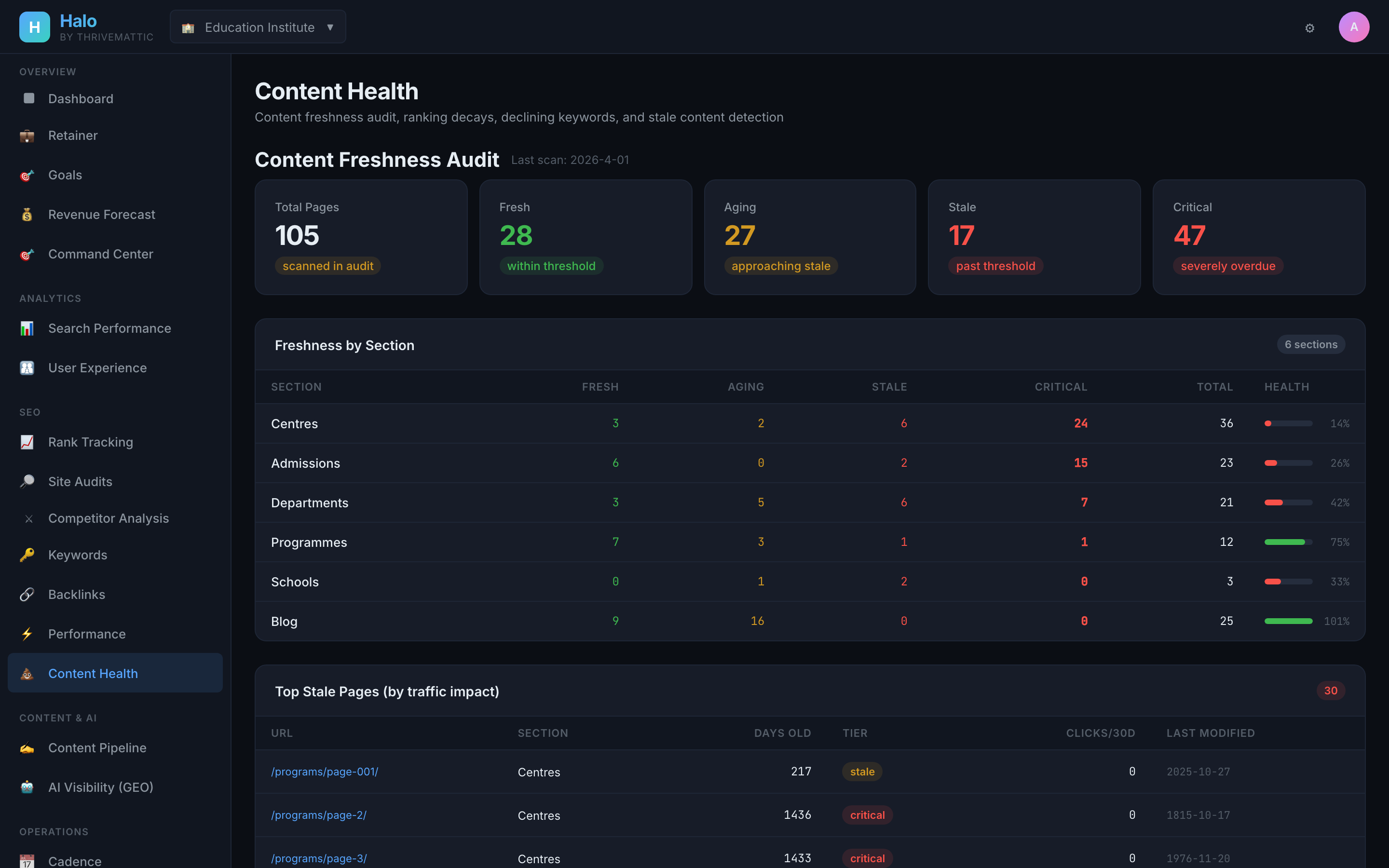
Content Health. Page-by-page freshness scoring across every indexed URL on your university site. Surfaces which program pages are decaying, which still drive prospective-student traffic despite going stale, and where keyword cannibalisation is hurting rank. Many universities discover that a placement-report page from a previous cycle still outranks the current one for the same query.
halo.thrivemattic.com / search-performance
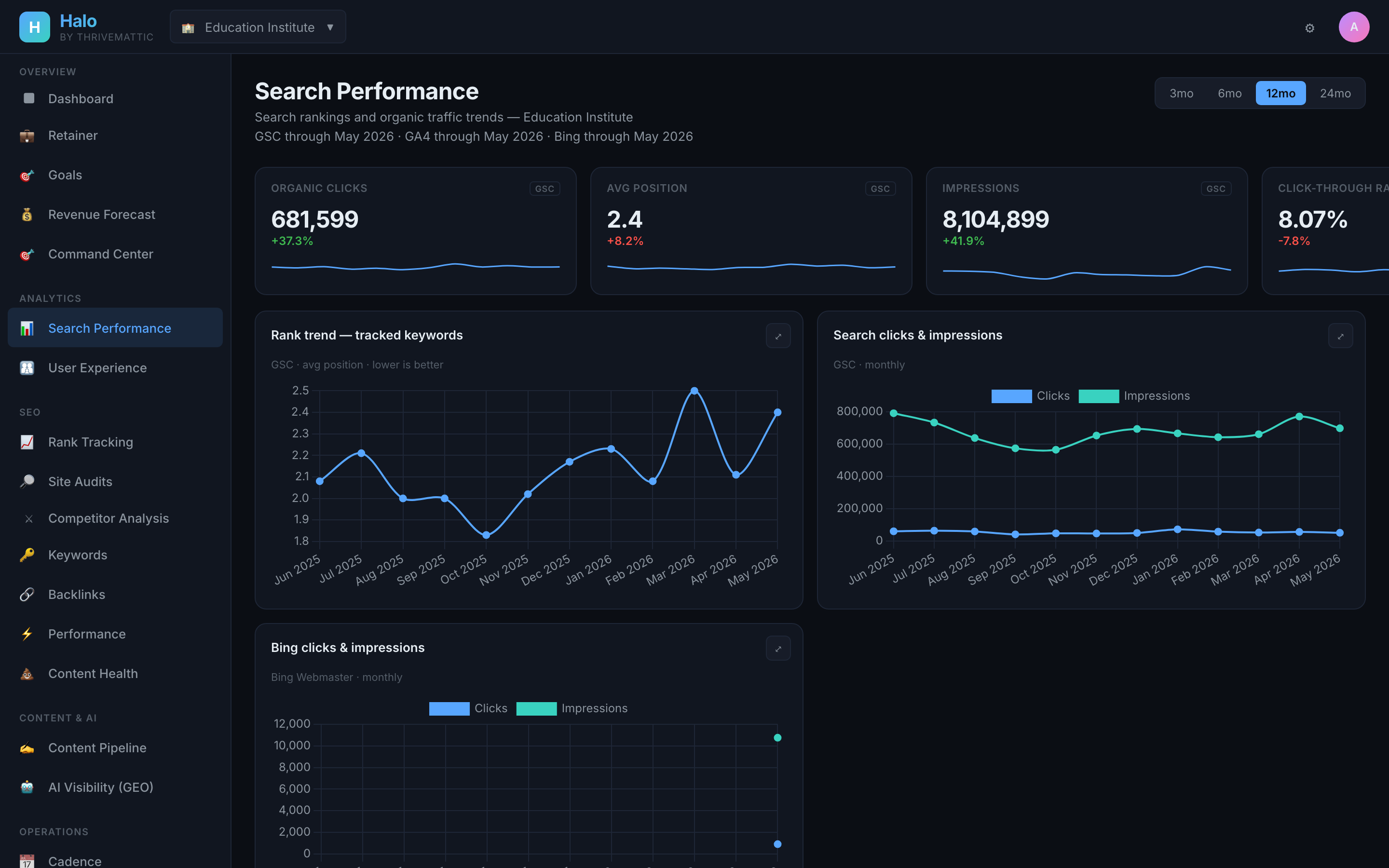
Search Performance. Organic clicks, average position, impressions, and click-through rate reconciled across Google Search Console, GA4, and Bing Webmaster. Twelve-month rank trend on tracked admissions and program-page keywords, with day-over-day movement flagged before it becomes a Board question.
halo.thrivemattic.com / ai-visibility
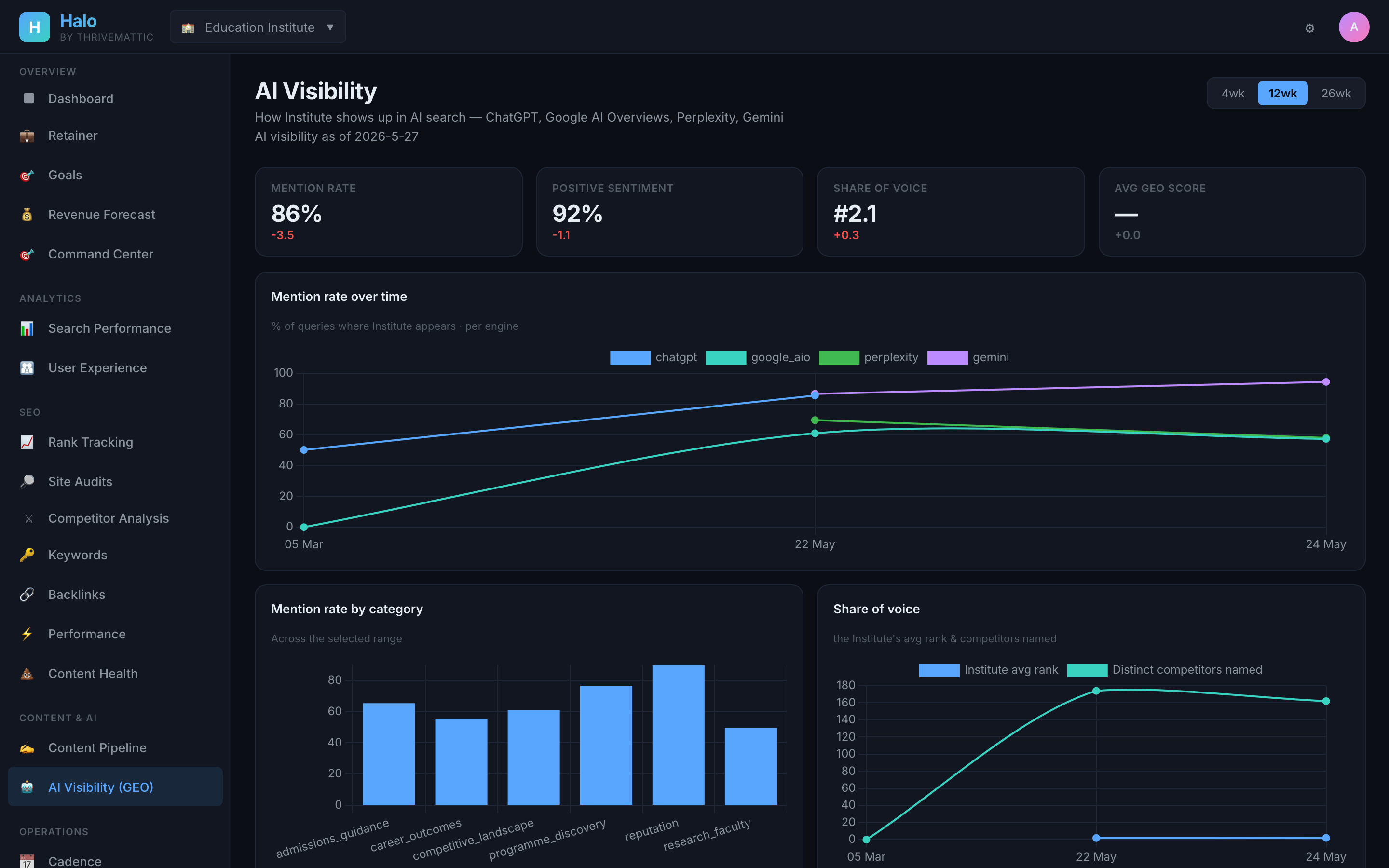
AI Visibility. Mention rate, positive sentiment, and share-of-voice across ChatGPT, Google AI Overviews, Perplexity, and Gemini. Mention rate by program category surfaces which schools and faculties AI engines name when a prospective student asks, and which they overlook.
Proof · Halo Live
Seven weeks at Ashoka University
Ashoka is a private liberal-arts university, and our first live Halo deployment. When Thrivemattic started in January 2026, the marketing office had SEO tools and tracking spreadsheets, but the workflows were largely manual: ad-hoc rank pulls, audits when something broke, and no AI visibility tracking at all. Seven weeks later, Halo was running every signal from one connected system on cadence. This is Halo working on a private-university engagement, not an analogy.
814
Keywords tracked daily across desktop & mobile
2,309
Pages audited, with 232,000+ findings triaged by severity
270,820
Rank snapshots collected over 7 weeks
156
Branded reports delivered automatically
320
AI visibility checks across ChatGPT & Google AIO
3
Peer universities monitored at the keyword level
55+
Custom AI queries tracked across six business categories
5
Cadence schedules, IST-aligned, multi-channel
Our 194-university study found that 178 of 187 universities (95.2%) own their own name on Google, yet ChatGPT, Gemini and Google’s AI Overview name only 111 of 194 (57.2%) when a student asks without naming one. The median mobile performance score across the cohort is 51 out of 100. Halo is the system that makes each of these visible inside the Vice-Chancellor’s office, on the schedule the admissions calendar already runs on.
Built with Ashoka University, one of India’s leading private liberal-arts universities. Halo’s intelligence layer surfaced site-wide regressions that had been compounding for months and would have remained invisible without continuous monitoring.
The Differentiator
Built for higher education, calibrated for universities
A generic SEO tool with a higher-ed skin would miss how a private university actually publishes, recruits, and reports to the Board. The five points to the right come from running Halo on university engagements and from our 194-university research.
- Admissions-cycle aware cadences. Reporting schedules respect UG admissions intake, PG application windows, and lateral-entry cycles, not arbitrary monthly cycles. Quarterly Board reports land before the meeting, not after. Daily briefs surface what matters during open-house weeks and application windows.
- Aggregator-aware competitor tracking. Halo’s Competitor Intelligence tracks aggregators such as Shiksha, CollegeDunia and Careers360 alongside your peer universities, because a prospective student comparing options meets both.
- Academic-content vocabulary. Custom AI queries are grouped around how prospective students and parents actually ask: programs and specialisations, faculty and research, placement outcomes, fees and scholarships, rankings and accreditation. Not generic SEO buckets.
- Four-country dataset. Halo trains on patterns across 500+ education institutions in India, UAE, Singapore, and Bahrain, spanning private universities, deemed universities, international schools, and NIRF colleges. The dataset informs the 194-university research benchmark and the 124-NIRF-college study.
- Open architecture, no lock-in. Built on Python + SQLAlchemy + Claude. PostgreSQL-ready. Your engagement data sits in a database your office can query, and the dashboard, Slack access, and report archive stay with you. If we are gone tomorrow, the system still works. See how we apply that across private-university engagements end to end.
Where this routes
Three next steps for private and deemed universities
Halo for Universities is the platform layer. The commercial engagement, the platform hub, and the research dataset sit alongside it. Pick the page that matches the question your office is asking right now.
Commercial engagement
Digital Marketing for Private Universities
The audit-and-fix engagement built on Halo. Speed, AI visibility, branded-search recovery, and an admissions-page rebuild scored against the 194-university benchmark.
Platform hub
Halo: the platform overview
The full Halo platform breakdown: 12 modules, 21 dashboard pages, 4 AI engines monitored, 5 reporting cadences. Same engine, different institutional applications.
The research
194-University Research
The full study: 194 private and deemed universities, eight evaluation dimensions, 18,838 Reddit posts analysed across 185 universities. The dataset that calibrates Halo for the university vertical.
See Halo working on your university
A 30-minute Discovery Call walks through the platform on your university’s data: current rank coverage, audit findings against the 194-university benchmark, AI visibility, branded-search exposure to aggregators, and a 60-day roadmap aligned to your next intake window.
Frequently Asked Questions
Common questions about Halo for Universities
Questions we get from Vice-Chancellors, Registrars, Directors of Admissions, and Directors of Marketing & Communications evaluating Halo against in-house digital teams or commodity SEO retainers.
What does the engagement cost, and how is it sized for a university?
Halo is bundled into every Thrivemattic university engagement. Two tiers serve universities: a diagnostic tier (Halo plus read-only access plus monthly review) sized for institutions that want to size the opportunity before scaling; and a team-operated tier (Halo plus our team running daily ops, weekly cadences, content production, and link building) sized to replace the work an in-house digital team of three or four people would need to do. Most universities start on diagnostic, then move to team-operated for the intake cycle. Both include the platform.
How does Halo align with NIRF, NAAC, and admissions cycles?
Cadence schedules respect NIRF submission windows, NAAC self-study cycles, UG and PG admissions intake months, and Board meeting dates. Quarterly Board reports are timed to land before Board reviews. The AI visibility module flags movement on ranking-adjacent and accreditation-adjacent queries so the office can respond inside the submission window, not in the following cycle. The 194-university research benchmark also gives a cohort-level reference point for where your university sits at each NIRF or NAAC submission.
How does Halo compare to an in-house digital marketing team?
A senior in-house digital team at a university (a digital lead, a content writer, a performance marketer, an SEO specialist) costs significantly more per month than a Thrivemattic engagement, before tools, training, and turnover risk. Halo lands the platform, the methodology, and a team that has studied 194 universities with this exact engine, in week one of the engagement. An in-house hire builds capacity over years. Halo’s database, dashboard, and reports stay with your university regardless of the relationship status. The two are complementary: Halo replaces the work the in-house team does not have headcount for.
Shiksha, CollegeDunia, and Careers360 outrank our own admission page. Can Halo fix that?
Halo cannot remove an aggregator from the SERP. It can show exactly which queries you are losing to them, which content gaps make the aggregator a better match in Google’s eyes, and which schema and content fixes have moved the needle on similar pages in our dataset. Most universities recover three to seven brand-adjacent queries inside the first ninety days of a team-operated engagement.
Does Halo integrate with our CRM (Salesforce, Slate, Microsoft Dynamics)?
Halo is the SEO and AI visibility platform. It tracks the top of the funnel: what prospective students see in search and AI engines, how they land on your site, and what they read. Your admissions CRM owns the rest of the funnel. We typically wire the two together through UTM tagging and GA4 attribution, so you can trace an enquiry from an AI engine citation through the application form into Salesforce or Slate. Direct CRM integrations vary by platform and are scoped in the engagement setup.
Is Halo a SaaS product we license, or part of a Thrivemattic engagement?
Halo is the platform behind every Thrivemattic engagement. We do not license it as standalone SaaS. The Halo dashboard, Slack bot, and report cadences come with the engagement. Your office uses them daily, while the platform itself is operated by ours. If we are gone, you keep the database, the dashboard, and the reports. Nothing locks you in.
What does the two-tier engagement model actually mean?
Tier one is the diagnostic engagement: Halo is wired into your site, your GSC, your GA4, and your AI visibility queries. You get the dashboard, the Slack bot, and a monthly review with our team. Sized for universities that want to know what they are sitting on before committing to ongoing work. Tier two is team-operated: everything in tier one, plus our team running the modules daily, drafting content, executing the audit fixes, managing link building, and sending the cadence reports. Most engagements move from tier one to tier two between months two and four, once the Board has seen the benchmark.
Can we see the dashboard before signing?
Yes. Book a Discovery Call and we walk through a live Halo instance on a deidentified institution so you can see what your university’s engagement would actually look like. We do not show client-specific data, but the platform shape and capability are fully visible. We can also share a slice of the 194-university benchmark so you can see where your peer set sits on each dimension.