
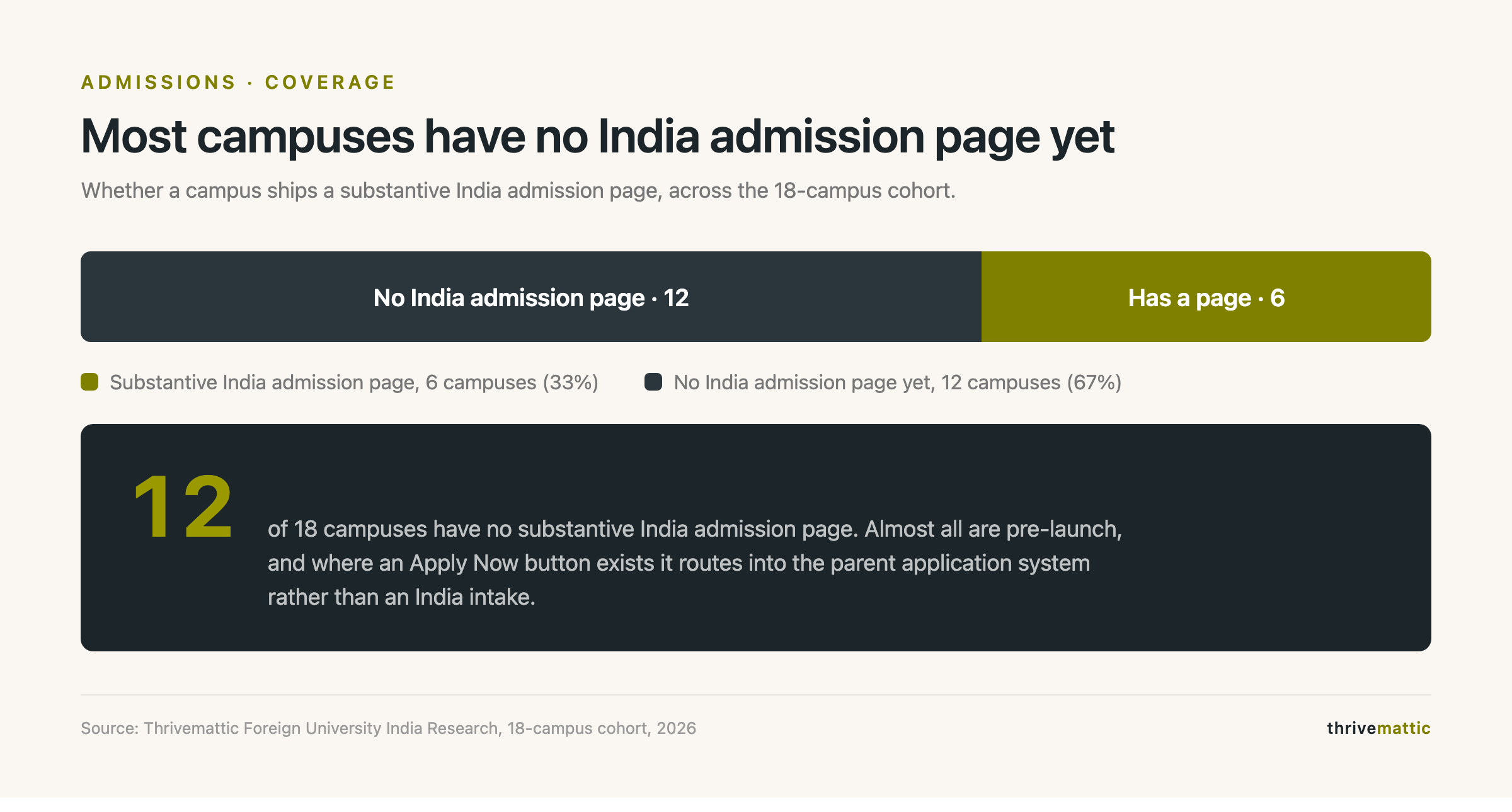
Eighteen foreign universities are building India campuses. Most launch this August. Only 6 ship a substantive India admission page today, and the spread between the best and the weakest is 20 points. Here is the concrete checklist an Indian applicant needs on that page, framed by what the cohort actually publishes.
An Indian student has decided they want a UK or Australian degree without leaving India. They have heard a campus is opening. They search the campus name, land on a page, and look for four things: what it costs in rupees, whether they qualify, when to apply, and how to apply. If the page cannot answer those questions clearly, the student does one of two things. They email an admissions inbox that may not be staffed yet, or they go back to an aggregator that has already framed the campus on its own terms.
This is the situation across the August 2026 launch wave. Thrivemattic crawled an 18-campus cohort spanning the UK, Australia, the US, and Italy. Most launch in August 2026. Four are already operational: Aberdeen Mumbai, Deakin GIFT City, Southampton Delhi, and Wollongong GIFT City. The rest are pre-launch. The full picture is in the foreign-university India research overview.
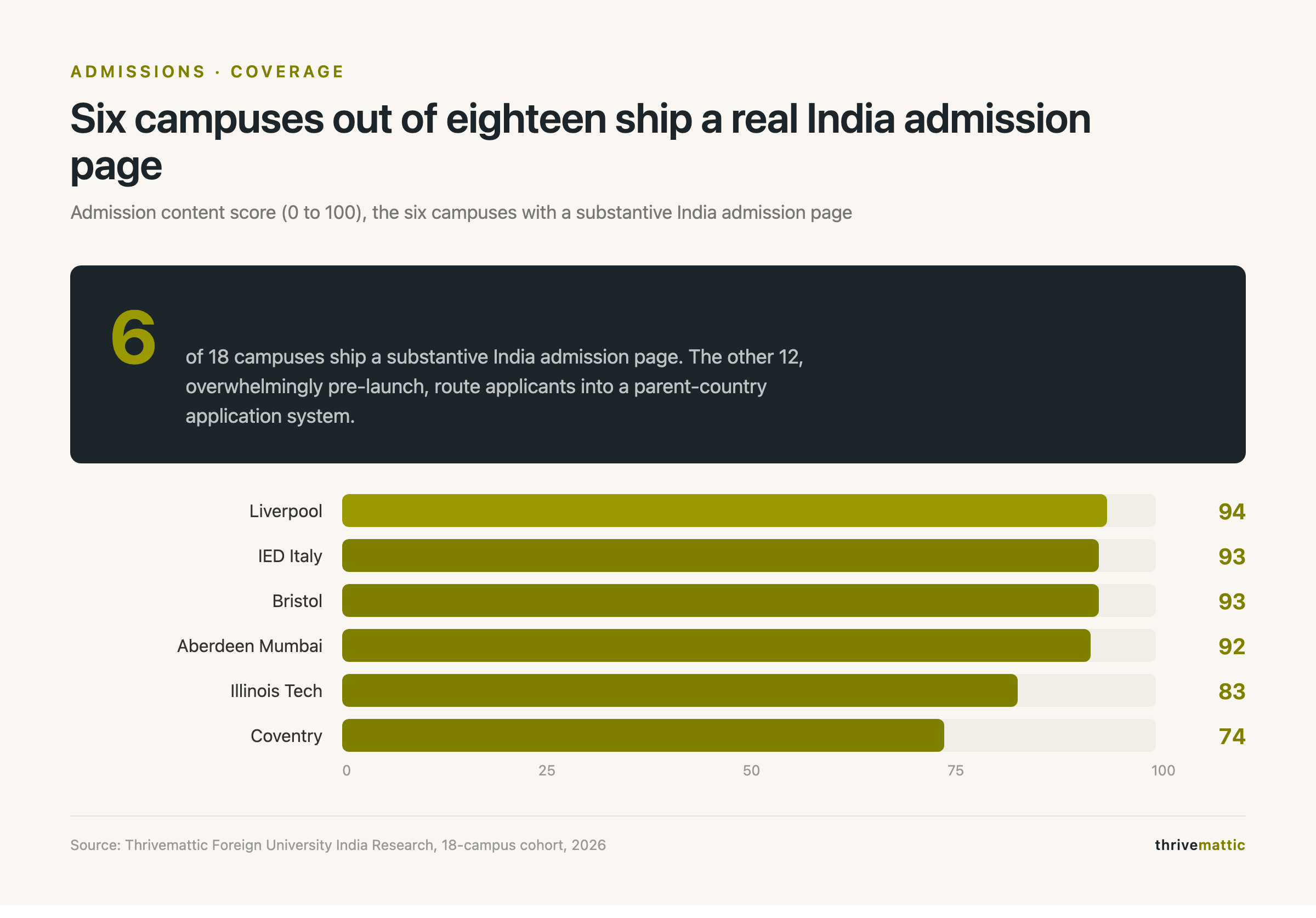
Six pages out of eighteen
We scored each campus on its India admission page across four dimensions: content completeness, depth, navigation, and technical execution, each contributing to a score out of 100. Only 6 of the 18 campuses ship a substantive India admission page at all. The six, with scores:
- Liverpool: 94
- IED Italy: 93
- Bristol: 93
- Aberdeen Mumbai: 92
- Illinois Tech: 83
- Coventry: 74
The other 12 have no India admission page yet. Most are still pre-launch, so the absence is expected rather than negligent. But pre-launch is exactly when the page should exist, because that is when search interest spikes and aggregators move fastest to fill the vacuum. The detail behind these scores is in the admissions journey report.
The spread among the six that publish is 20 points, Liverpool at 94 down to Coventry at 74. That gap is the difference between a page an Indian applicant can act on without contacting anyone and a page that answers some questions and forces a call for the rest. The checklist below is built from what separates the top of that range from the bottom.
The 20-point gap is Content Depth and Technical Excellence
Each campus’s admission-page score, broken into the four dimensions it is built from. The top four cluster within 2 points of each other on every dimension. Illinois Tech and Coventry diverge on Content Depth and Technical Excellence — not on Content Completeness or UX Navigation. Hover or tap any segment for the detail.
Look at the decomposition. The top four campuses are nearly identical on every dimension — Content Completeness 35, Content Depth 16-17, UX Navigation 23-24, Technical Excellence 18. The 20-point gap to Coventry is not spread evenly across the four dimensions. It is concentrated in Content Depth, which falls from 17 to 10, and Technical Excellence, which falls from 18 to 13. Coventry’s content checklist is mostly present. The detail under each checklist item is not.
That pattern is the practical takeaway. The page either has substantive India-specific detail under each section, or it has the section heading and a sentence. The first scores high, the second scores low, and the difference is what Indian applicants experience as “this page answered the question” versus “this page mentioned the question.”
The four questions every page has to answer
Before the checklist, the frame. An Indian applicant evaluating a foreign campus is not a generic international prospect. They are a domestic student making a domestic decision about a foreign brand. Four questions decide whether the page works.
What does it cost in rupees? Not GBP, not AUD, not USD with a currency note. The applicant and the person paying the fees think in INR. A foreign-currency figure forces a mental conversion and a separate question about exchange rate risk. An INR figure, even an indicative band with a stated conversion date, removes friction at the most decisive moment on the page.
Do I qualify, under Indian criteria? Indian applicants arrive with CBSE, ICSE, or state board marks, an Indian undergraduate degree, and Indian English-test history. Eligibility stated in the parent university’s home format (A-levels, ATAR, GPA on a 4.0 scale) leaves the applicant guessing. The page has to map eligibility to Indian qualifications explicitly.
When do I apply, on the India calendar? The India campus intake calendar is not always the parent university’s calendar. An August 2026 launch implies India-specific deadlines that the applicant cannot infer from the parent site.
How do I apply, to this campus specifically? This is where most of the cohort fails hardest, and it has its own section below.
The application route problem
Where the 12 campuses without an India admission page do surface an “Apply Now” control, the link routes into the parent university’s application flow. For UK campuses that means a UCAS-style international application. For Australian campuses it means the parent university’s Australian application system. In both cases the flow defaults to an international-student context: international fee schedules, international document requirements, visa-linked steps, and an offer process designed for a student physically relocating abroad.
An Indian applicant to an India campus is not relocating abroad. They are applying to a campus in Mumbai, Delhi, or GIFT City. Sending them into the parent university’s international funnel does real damage: it misprices the offer, asks for documents that do not apply, and signals that the India campus is an afterthought bolted onto a foreign admissions machine. The campuses that score well expose a campus-named application route distinct from the parent system. That single design decision accounts for much of the 20-point spread.
The checklist
The list below is organised in three tiers. Tier 1 is non-negotiable for any campus accepting applications. Tier 2 is what separates a credible page from a placeholder. Tier 3 is what the top of the cohort does that the rest does not. Every item is auditable. The page either has it or it does not.
Tier 1: Must-have, visible without scrolling
- Fees in INR. An indicative annual figure or band in rupees, with the conversion basis and date stated if it is derived from a foreign-currency tuition figure. “Contact us for fees” is a failure.
- India-specific eligibility, mapped to Indian qualifications. State the minimum in CBSE, ICSE, and state board terms, plus the accepted English-test scores. Do not restate A-levels or ATAR alone.
- India intake deadline and start date. The actual application deadline for the India campus and the August 2026 (or relevant) start date, on the India calendar, not the parent university’s.
- A campus-named application route. A single prominent control that opens an application flow specific to this campus, not a redirect into the parent UCAS-style or Australian system in international-student mode.
Tier 2: Must-have, within one click
- Document requirements for Indian applicants. Exactly which Indian transcripts, mark sheets, and certificates are needed, and in what form.
- Step-by-step application process with timeline. Numbered stages from submission to offer, with expected duration per stage, written for an applicant who is staying in India.
- Programme list with India availability flagged. Not every parent programme runs at the India campus at launch. State which programmes are available in India in the first intake.
- Scholarship and financial-aid options for Indian applicants. With eligibility criteria stated against Indian qualifications, and amounts expressed in INR.
- A staffed, named India contact. A campus admissions contact (email, phone, or WhatsApp) that resolves to a person handling India applications, not a generic global enquiries inbox.
Tier 3: Differentiators the top of the cohort gets right
- Accreditation and regulatory clarity. State plainly how the India campus is recognised: UGC status, the relevant IFSCA authorisation for GIFT City campuses, and what the degree is, who awards it, and whether it is the parent university’s degree. Indian applicants and parents treat this as a gating question, and ambiguity here loses high-intent applicants who cannot risk an unrecognised qualification.
- Degree-parity statement. An explicit statement of whether the India-campus degree is identical to the one awarded on the home campus, including transcript and certificate wording.
- Pathway and transfer clarity. Whether a student can move between the India campus and the home campus, on what terms, and at what additional cost in INR.
- An India-context FAQ. The actual questions Indian applicants ask: recognition, parent-degree parity, INR fees, board-mark eligibility, India deadlines. Derived from real enquiries, not a generic template.
- Outcomes evidence relevant to India. Placement, progression, or alumni evidence that an Indian applicant can read against an Indian context, with the year and basis stated.
- Consistent figures across every property. The fee, deadline, and eligibility figures on the page match what appears on aggregator profiles and in AI-assistant answers. Where the figures diverge, the higher-intent query is where trust is lost. The cross-property picture sits in the SERP report.
What the top of the cohort does differently
Liverpool, IED Italy, Bristol, and Aberdeen Mumbai cluster in the 92 to 94 range for three structural reasons that go beyond ticking individual items.
One authoritative India hub. A single URL is the definitive India admission starting point, with clear navigation to programme detail, fees, deadlines, and the application route. It is not a marketing landing page with a hero image and a paragraph. Students and parents bookmark it, and search engines treat it as the canonical page for the campus.
The application route is campus-native. The apply control opens a flow built for this campus and this applicant, not a deep link into the parent university’s international funnel. This is the single largest differentiator across the 20-point spread.
Regulatory and degree questions are answered on the page, not deferred. Accreditation status, awarding body, and degree parity are stated in plain language where the applicant is already looking, not pushed to a PDF or an email.
Coventry at 74 is instructive in the other direction. The page exists and covers the basics, but the depth and navigation gaps that pull it 20 points below Liverpool are exactly the Tier 2 and Tier 3 items above. The content mostly exists across the parent estate. The work is to localise it to the Indian applicant and consolidate it into one India hub.
How to audit your India admission page this week
This is a three-step process that needs no external tooling and produces a prioritised action list.
Step 1: Score the page against the 15 items. Mark each item Present, Partial, or Missing on your live India admission page and on any programme pages linked from it. Pay closest attention to the four Tier 1 items, because a gap there sends a ready-to-apply student to an aggregator.
Step 2: Trace the application route. Click your own “Apply Now” as an Indian applicant would. If it lands in the parent UCAS-style or Australian flow in international-student mode, that is the highest-priority fix in this list, regardless of how the rest of the page scores.
Step 3: Check figure consistency. Compare the fee, eligibility, and deadline figures on the page against aggregator profiles for the campus and against what AI assistants return for “[campus] India fees.” Flag every divergence. The technical and discoverability context for this step is in the technical report.
After these three steps you have a scored page, a routing verdict, and a consistency gap list. For most of the cohort, that is enough to move from no India page to a page an Indian applicant can act on before August 2026.
What this means for the launch wave
The data is direct. Twelve of eighteen campuses have no India admission page, and several launch in months. Among the six that publish, a 20-point spread separates a page that converts a ready applicant from one that loses them at the fee line or the apply button. None of the gaps in this checklist require a redesign. They require localising existing content to the Indian applicant and exposing a campus-native application route. The campuses that do this before the August intake will convert the search interest the launch creates. The ones that do not will hand that interest to aggregators and to the parent university’s international funnel, then explain enrolment numbers they cannot account for.
This is Part 2 of a 5-part series based on Thrivemattic’s 18-campus foreign-university India research. For the full admissions data, see the Admissions Journey report. For related findings on search ownership and technical execution, see the SERP report and the technical report.
We hold a per-campus admissions assessment for each of the 18 India campuses, showing exactly which of these checklist items the campus covers, where the application route leaks, and a prioritised pre-launch action plan. If you’re planning your India-campus launch, here’s how we help →